Welcome to HITOP FORKLIFT
EN

Language

Language
Save
icon Inquiry cart ( 0 )
News & Events

How is the prospect of "oil-to-electricity" forklifts?

Views : 824
Author : HITOP
Update time : 2021-05-12 12:13:00
The topic of "oil-to-electricity" forklift has been lively for some time, and it is still in progress. So, what is the prospect of "oil-to-electricity" forklifts? We can refer to the experience and lessons of the automotive industry.

Not long ago, a new energy vehicle sales ranking list was released. In the top 10 list, new energy vehicles built on the exclusive platform of pure electric accounted for 6 seats, and sales accounted for 60%. It has become the main force in the new energy vehicle market. In other words, the market is cruelly phasing out the so-called "oil-to-electricity" models. So, what about the prospects of "oil-to-electricity" forklifts? Manufacturers do not count, experts say not to count, only the market has the final say.
 
The so-called "oil-to-electricity", as the name implies, is to take out the fuel engine, gearbox, mechanical drive shaft and other structures under the condition that the fuel vehicle platform structure is basically unchanged, and then replace it with an electric motor, lithium battery pack, and electronic control system. Immediately transformed into a new energy electric vehicle, the characteristics are simple and crude, convenient and fast, low cost, fast time, and low research and development costs. This solution can help manufacturers convert fuel trucks into new energy forklifts at the fastest speed and low cost. It is especially attractive for some forklift OEMs with weaker new energy technologies, and they can completely rely on external suppliers. To provide an overall oil-to-electricity technical solution and core components, and quickly introduce new energy forklifts to the market.
It is undeniable that in the transition from traditional internal combustion forklifts to new energy forklifts, fuel-to-electricity is the most simple and practical technical solution, which can make full use of the very mature and reliable complete machine technology of internal combustion forklifts and the efficient, complete and low-cost supply chain system. Quickly enter the field of new energy forklifts. In addition to the advantages of very low cost, this solution does not require much effort in research and development. Although the current oil-to-electricity schemes and degrees of various manufacturers are not the same, the essence is the same, that is, power transplantation is carried out on the basis of fuel vehicles. Although there will be detailed optimization, it does not give full play to what the electrification system should have. It does not increase any technical added value, which is fundamentally different from the pure electric platform specially developed.

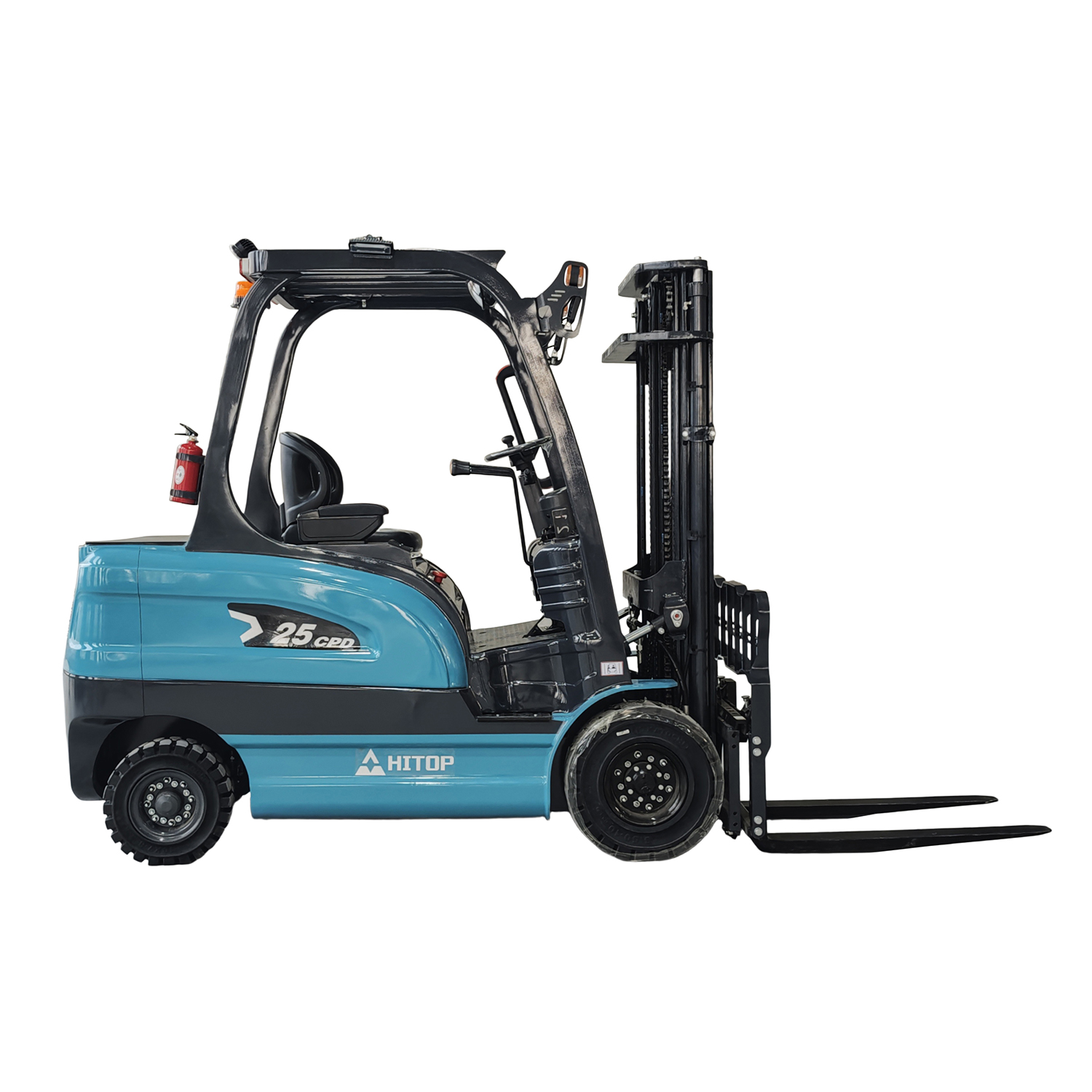
The new energy electric forklifts that are based on pure electricity research and development often require a lot of time and money during research and development. Since the beginning of the design, forward-looking structural design must be carried out according to the characteristics of the electric forklift, completely in accordance with the lithium battery, electric motor, and control. The performance characteristics and structure of the system are tailor-made, and appropriate space is reserved for the layout of the battery and the motor, so that the battery, electronic control, and motor can be organically integrated. From the frame to the transmission, from the tire to the brake, it is all through Specially designed, the battery pack can be placed in the most ideal position, the vehicle rigidity is better, there is a safer battery protection system, the center of gravity of the car body is distributed lower and more uniform, the battery life is longer, the operating performance and the fuel-to-electricity Forklifts are not the same thing.
 
Although theoretically speaking, the new energy forklift from oil to electricity is only a transitional product in the development of new energy forklifts. However, existence must have its rational side. "Oil-to-electric" forklifts basically start from the 3 ton internal combustion forklift with the largest sales in the market. Some of the oil-to-electric forklifts have good performance, and the price is low, and they are targeted at a wide range of customers. There is still a certain amount of sales in the usage scenarios of working conditions, which can also bring some benefits to manufacturers. Therefore, before the price of new energy forklifts can not be fully reduced, the "oil-to-electric" forklifts still have room for survival. After all, for users, whether it is oil-to-electricity or new energy, it is just a forklift. The standard is only the price and whether it is easy to use. This is also an inevitable product of the energy transformation stage, but there is no room for sustainable development.
From a technical analysis, the "oil-to-electric" forklift has many inherent defects, which is essentially a method of changing flowers and trees. According to market research, it is generally reported that the continuous working hours are not long. The endurance of electric forklifts mainly depends on battery capacity and energy efficiency. First, the battery capacity depends on the number of batteries. The internal structure of the fuel vehicle does not specifically reserve space for the battery, so the battery pack that is added later can only be inserted into the vehicle at a seam, and the capacity that can be provided is very limited. Secondly, the energy consumption efficiency largely depends on the matching of the power transmission structure, and the oil-to-electric forklift is only replaced with motors, electronic controls and battery packs in the mechanical space of the already formed fuel truck frame. Since it is not a complete vehicle research and development, the transmission energy efficiency is not the best match. The performance of the whole machine is naturally unsatisfactory. The performance of an electric forklift mainly depends on the performance of the electric motor and the efficiency of the transmission structure, while the transmission structure of the oil-to-electric model is after all They are all transplanted, their mechanical integration is lower, and the coordination between the modules is not tacit, resulting in low transmission efficiency.
 
Although the "oil-to-electricity" forklift has great advantages in terms of cost and development cycle, the limitations of innate deficiencies are still very large, and such effects cannot be eliminated through acquired efforts. Moreover, because the oil-to-electricity conversion lacks an innovative R&D process, it has brought about extremely low-value technological changes. The result of this long-term result is that the new energy technology is pacing or even stagnating. After all, only Genzheng can achieve Miaohong. With the continuous improvement of new energy technology, new energy electric forklifts based on the positive development and design of pure electric platforms must be the mainstream of the future. Those who take advantage of the trend will prosper against the trend, and the survival of the fittest is the eternal principle of every industry. Similarly, there is no shortcut to the development of new energy forklifts. Only by being down-to-earth, serious and pragmatic can we go further.
 
Related News
Read More >>
How Long Do Forklifts Last? How Long Do Forklifts Last?
Dec .25.2025
Discover the average forklift lifespan (hours & years), key factors that affect durability, and practical tips to extend your forklift's service life. Learn when to repair or replace.
Customized RAL Color Forklifts, Scissor Lifts & More Shipped to Paraguay Client Customized RAL Color Forklifts, Scissor Lifts & More Shipped to Paraguay Client
Sep .29.2025
HITOP FORKLIFT, a leading supplier of premium material handling and aerial work equipment, is proud to announce the successful shipment of a diverse range of industrial machinery to a valued client in Paraguay. This order underscores our commitment to supporting industrial growth and operational efficiency across South America.